
How to Build a Sales Funnel for Coaches: A Practical Step-by-Step Guide
If you're a coach looking for more clients, you've probably heard that you need a sales funnel.
You might have seen people recommending landing pages, lead magnets, email sequences, booking calendars, automated follow-ups and CRM systems. You may even have purchased several tools, only to find yourself unsure how to connect everything together.
But here's the thing: a sales funnel isn't really about the technology. It's about helping the right people move from discovering you to deciding whether they want to work with you.
The technology simply helps you manage that journey.
In this guide, we'll walk through how to build a sales funnel for your coaching business, from attracting potential clients to onboarding paying customers. We'll use a practical example throughout, so you can see how the different pieces fit together and adapt them to your own offer.
You don't need to build everything at once, and you don't need an expensive collection of software to get started.
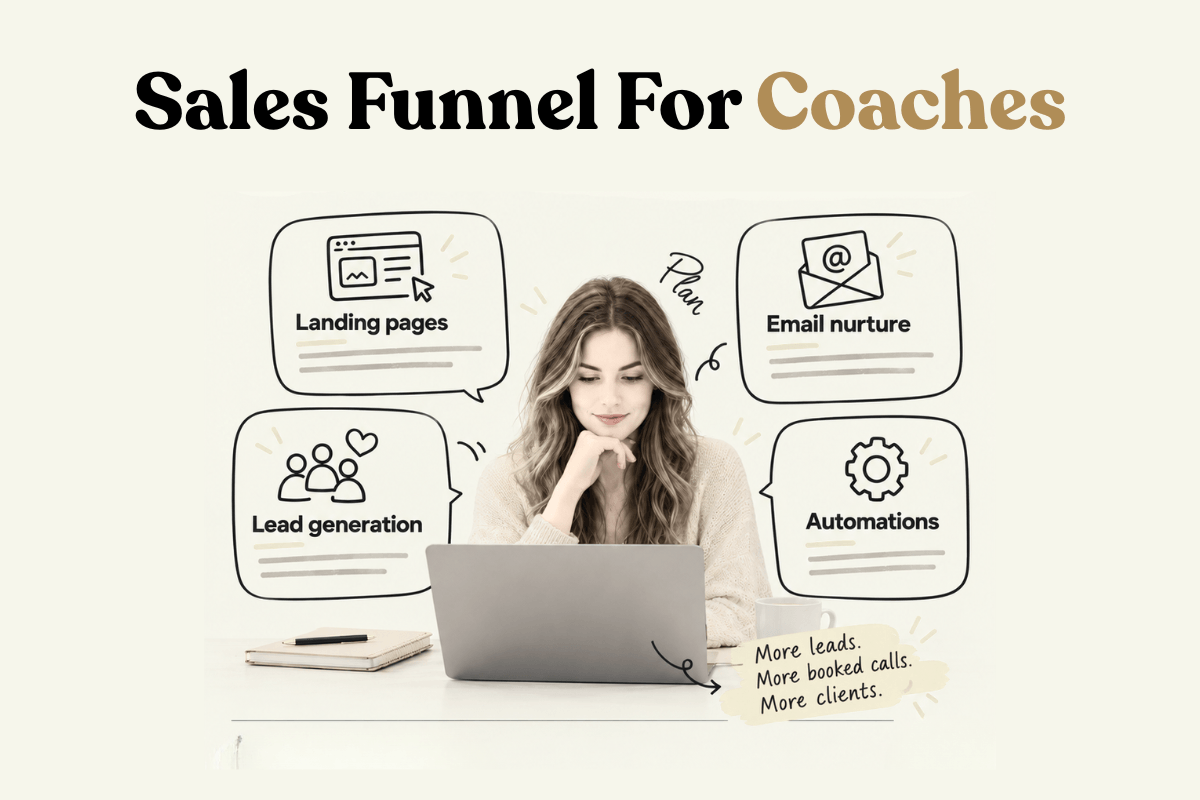
Let's begin with the part that matters most.
1. Understand What a Sales Funnel Is Actually Supposed to Do
Imagine your ideal customers are sitting just a few steps away from you.
You know you have a coaching program that could help some of them. You want them to understand what you offer and, if it's right for them, eventually become your clients.
Would you walk straight up to them and shout, "Buy my course!" or "Book a call with me!"
Probably not.
You'd start a conversation. You might share something useful, ask about the challenges they're facing, or explain how you've helped someone in a similar situation. If they're interested, you'd tell them more about what you do and how they could work with you.
A sales funnel should work in a similar way.
The goal isn't to push everyone towards a purchase as quickly as possible. It's to help the right people understand their problem, discover possible solutions, see whether your offer is suitable for them, and decide what to do next.
This means your funnel needs to answer several questions along the way:
How will potential clients discover you?
What can you offer that gives them a useful reason to engage with you?
How will you help them understand their problem and the solutions available?
How will they learn whether your coaching is right for them?
What should they do if they're interested?
What happens after they take that step?
If they become a client, how will you help them get started?
Your landing pages, emails, forms, calendars and automations should support these steps.
If you build the technology before thinking through the customer journey, you may end up with a collection of disconnected tools rather than a system that helps you get clients.
A running example
Throughout this guide, imagine you're a business coach who helps solo consultants turn their expertise into a clear, sellable service offer.
Your potential clients are good at what they do, but they struggle to explain their services clearly. They may write proposals that don't communicate their value, attract enquiries from people who aren't a good fit, or find it difficult to explain why their services are worth the price.
Your coaching program helps them clarify their offer, communicate its value and create a more consistent way of selling their services.
We'll use this example to build a simple funnel from beginning to end.
2. Define Who You Help and What You Help Them Achieve
Before choosing software or creating a landing page, get clear about your coaching offer.
You don't need a complicated marketing framework. You need to be able to explain three things:
Who do you help?
Be specific about the people you want to work with. "Anyone who wants to grow their business" is too broad to guide your marketing.
Our example coach might work with solo consultants who already have expertise and clients but struggle to package their services into a clear offer.
What problem do you help them solve?
Describe the problem in terms your audience would recognise.
For example, they may find themselves explaining their services differently to every prospect because they haven't defined exactly what they're selling.
Use the words your audience actually uses, rather than relying on marketing terminology they may not understand.
If you're not sure what those words are, speak to existing clients and potential customers. Ask what they struggle with, what they've already tried and what they wish were easier.
These conversations can give you more useful insights than guessing what your audience wants.
What outcome does your coaching help them work towards?
Explain what could improve as a result of working with you.
Our example coach might help consultants create a clear service offer, communicate its value and approach sales conversations with more confidence.
Be realistic about what you can promise. Coaching outcomes depend on the client's starting point, effort, circumstances and other factors. You can explain what your program is designed to help with without guaranteeing a particular financial or business result.
Once you can explain these three things clearly, it becomes much easier to decide what content to create, what free resource to offer and how to present your paid program.
3. Give People a Useful Reason to Start the Conversation
People who have never heard of you may not be ready to buy your coaching program. They may not even realise how you could help them.
Instead of immediately asking them to book a call or buy your course, offer something useful that addresses a problem they already recognise.
Depending on your coaching offer, this could be:
A guide or checklist: Help people understand a problem or take their first steps towards solving it.
A quiz or assessment: Help them identify where they are now, what might be holding them back or which approach might suit them.
A workshop or short training: Teach them something they can apply to their own situation.
A trial, sample lesson or practical exercise: Let them experience your teaching approach before committing to a larger program.
A useful conversation: Invite them to discuss their challenges when a conversation is genuinely the best next step.
For our business coach, a useful starting point could be a free Service Offer Clarity Worksheet.
The worksheet helps consultants work through three questions:
What service do I provide?
Who benefits most from this service?
Why would someone choose my service instead of another option?
Someone who completes the worksheet may realise that their offer is still too vague. They now have a better understanding of their problem and a reason to explore possible solutions.
The free resource isn't just a way to collect an email address. It should deliver real value on its own while helping the right people recognise the next step they may need.
How do you choose the right lead magnet?
Start with a problem your potential clients already recognise, rather than a topic you simply want to teach.
Ask yourself:
What are they struggling with before they consider hiring a coach?
What small but meaningful result could they achieve with a free resource?
What would they understand about their situation after using it?
How does that problem connect naturally to my paid coaching offer?
For example, a consultant who cannot explain their service clearly may benefit from a worksheet that helps them identify their offer. Someone who already has a clear offer but struggles to attract enquiries may need a different resource.
Your lead magnet should attract people who are relevant to your business, not just anyone willing to exchange an email address for a free download.
4. Create a Landing Page That Makes the Next Step Clear
Once you have a useful resource, you need somewhere to introduce it and allow people to access it.
This is where a landing page comes in.
A landing page is a focused web page designed to encourage a particular action. In this case, the action is signing up to receive your free resource.
You don't need a complex design. You need to communicate why the resource matters and what someone should do to get it.
A simple landing page usually includes:
A clear headline
Focus on the problem or outcome rather than the name of your resource alone.
For example:
Struggling to Explain What Makes Your Consulting Service Worth Paying For?
A short explanation
Explain what the resource helps people do and who it is for.
For example:
"If you're good at what you do but struggle to explain your service clearly, this worksheet will help you identify who you serve, what you offer and why it matters to your potential clients."
A few specific benefits
Tell visitors what they will be able to work through or understand.
For example:
Identify the people who benefit most from your service.
Clarify the problem your service solves.
Explain the value of your offer in simpler language.
A clear call to action
Use a button that tells people what will happen next, such as "Get the Free Worksheet."
A simple form
For a basic resource, you might only need their name and email address. Don't ask for information you don't genuinely need at this stage.
Here is an example of how the page could be structured:
Struggling to Explain What Makes Your Consulting Service Worth Paying For?
Download the free Service Offer Clarity Worksheet and work through the questions that help you define who you serve, what you offer and why it matters.
In a few guided steps, you'll start putting your service into words that make sense to potential clients.
[Get the Free Worksheet]
This is enough to communicate the purpose of the page without overwhelming visitors.
What happens after someone submits the form?
This is where your landing page needs to connect to the rest of your funnel.
At a minimum, the person should receive the resource they requested. You should also make it clear what happens next.
For example:
The visitor submits the form.
Your system records their details.
They see a confirmation message or thank-you page.
They receive an email containing the worksheet.
If they have agreed to receive your follow-up marketing, they can begin receiving relevant emails.
You can automate these steps so you don't have to send every resource manually.
However, don't assume that requesting a download automatically means someone has agreed to receive every type of marketing communication. Make your sign-up terms clear and follow the consent and privacy requirements that apply to your business and audience.
5. Help People Understand Your Offer Before Asking Them to Buy
Getting someone's email address is only the beginning.
They may find your free resource useful but still have questions. They may not fully understand their problem, know what kind of help they need, or be ready to invest in coaching.
This is where nurturing comes in.
Nurturing means continuing to provide relevant information that helps potential clients understand their situation, evaluate possible solutions and decide whether your offer is right for them.
Email is one way to do this, but the principle applies to your articles, videos, workshops and conversations too.
Help them understand the problem
Describe situations they recognise from their own experience.
For our business coach, you might explain why consultants struggle to communicate their value when their service offer is too broad.
You could show how trying to customise a different explanation for every prospect makes selling more difficult, then share a practical way to describe the service more consistently.
The aim isn't to make people feel inadequate or frighten them into buying. It's to help them understand the problem and why addressing it may matter.
Help them imagine a realistic improvement
People need to understand not just what they are struggling with, but what could be different.
For example, a consultant with a clear service offer may find it easier to explain their work, assess whether enquiries are relevant and prepare proposals that communicate their value.
You can explain what your coaching is designed to help them achieve and how you approach the work.
Avoid implying that every client will achieve identical results. Show a credible path forward rather than promising a perfect outcome.
Explain how your coaching can help
Don't jump straight into listing everything included in your program.
Connect your approach to the problem your audience wants to solve.
Consider these examples:
Feature | Explain why it matters |
|---|---|
12 weekly coaching sessions | Receive guidance as you work through the challenges of clarifying and communicating your offer. |
Worksheets and templates | Turn what you've learned into practical steps without starting from a blank page. |
A private community | Exchange ideas and get support from people working through similar challenges. |
Recorded lessons | Revisit the material when you need a refresher. |
Features still matter because people need to know what's included before buying. But the features become more meaningful when you explain how they may help.
A useful test is to ask yourself: "If someone reads this feature, will they understand why it matters to them?"
If not, explain the benefit in plain language.
Give people a clear next step
If someone wants to learn more, don't leave them guessing what to do.
Depending on your offer and how ready the person is, the next step could be reading your program details, attending a workshop, booking a conversation or enrolling directly.
Tell them what will happen after they take that step.
For example:
"Book a free 20-minute conversation. We'll discuss your current offer, identify where it may be unclear and see whether my coaching is suitable for your situation. There's no obligation to join."
That is much more informative than a button that simply says "Book Now."
A practical five-email sequence
You don't need dozens of automated emails to start. A short sequence can help people use your free resource, understand their problem and explore the next step.
Here's an example for our business coach.
Email 1: Deliver the resource
Subject: Your Service Offer Clarity Worksheet
Hi [First Name],
Here's your Service Offer Clarity Worksheet: [Access the worksheet]
Set aside a little time to work through the questions. You don't need perfect answers straight away. The goal is to start putting your service into words that make sense to the people you want to help.
As you go through it, pay attention to any question that's difficult to answer. That may be a useful place to focus first.
Joey
Email 2: Help them recognise a common problem
Subject: Why explaining your service can feel so difficult
Hi [First Name],
Have you ever found yourself explaining your service differently to every potential client?
Sometimes this happens because we know our work so well that we struggle to simplify it. We describe everything we can do instead of helping people understand which problem we solve for them.
Try finishing this sentence:
"I help [specific type of person] solve [specific problem] so they can [meaningful outcome]."
It doesn't have to be your final version. It's simply a starting point for making your offer easier to understand.
Joey
Email 3: Share a useful approach
Subject: One way to make your offer clearer
Hi [First Name],
Try describing your service from your client's point of view.
Instead of starting with the process you use, start with the problem your client wants to solve.
For example, "I provide consulting services using my proprietary framework" tells someone relatively little about why they might need your help.
"I help independent consultants turn their expertise into a clearly defined service that potential clients can understand" gives them a better idea of the problem you address.
The right wording will depend on your audience and what you genuinely offer, but the principle is the same: make the connection between your work and their needs clear.
Joey
Email 4: Explain how your coaching works
Subject: When is it worth getting help with your offer?
Hi [First Name],
Working through your offer on your own can be a useful first step.
But sometimes you need another perspective to identify what's unclear, understand how potential clients interpret your message or decide what to change.
That's one reason coaching can be helpful. You have someone to work through the questions with you, challenge your assumptions and help you apply what you've learned to your own business.
If you'd like to understand how I help consultants work through this process, you can learn more here: [Link to coaching program]
Joey
Email 5: Offer a clear next step
Subject: Would it help to talk through your offer?
Hi [First Name],
If you've been working through your service offer and would like another perspective, you're welcome to book a conversation with me.
We'll discuss what you're offering, who you're trying to reach and where you're finding it difficult to communicate your value.
We'll also work out whether my coaching is a suitable next step. If it isn't, that's fine too.
You can find the details here: [Booking link]
Whatever you decide, I hope the worksheet has helped you think more clearly about your offer.
Joey
These emails are examples, not a sequence you must copy word for word. Adapt them to your audience, your personality and the way you genuinely work with clients.
You can automate delivery and scheduling, but the content should still sound like you and reflect what you can actually help people do.
6. Decide Whether You Need an Application Form or Just a Booking Page
Many sales funnel templates put an application form before a booking calendar. But that isn't necessarily the right approach for every coach.
The decision depends on your business stage, the demand you have and the kind of coaching you provide.
If you're just starting out, make it easy for people to talk to you
When you don't yet have a steady stream of prospects, your priority is often learning.
You need to understand what potential clients are struggling with, which words they use to describe their problems, what they've tried, what concerns them and what they need before deciding to buy.
A booking page with a simple calendar may be enough.
You can invite interested prospects to book a short conversation, then use those conversations to improve your offer and messaging. You may discover that the problem you thought mattered most isn't the one your audience is most concerned about.
You may also learn which objections keep coming up and what information people need before they feel comfortable buying.
This is valuable feedback that can improve your sales page, emails and coaching program.
Don't introduce unnecessary friction before you have a clear reason to do so.
An application form can discourage people from taking the next step, particularly when they don't know you well yet.
There are exceptions, of course. If your coaching requires specific eligibility, involves sensitive or specialised circumstances, has very limited capacity, or would be unsuitable for certain people, screening may be necessary from the beginning.
Add an application form when it solves a real problem
As your business grows, you may reach a point where you receive more booking requests than you can reasonably handle.
You may also find that many people booking calls aren't a good fit for your offer, can't afford the program, or need a different kind of help.
At that point, an application form can help you understand a prospect's situation before you schedule a conversation.
You might ask:
What are you currently trying to achieve?
What is your biggest challenge?
What have you already tried?
What kind of support are you looking for?
Is there anything else I should know before we speak?
Only ask questions that help you decide whether the conversation is appropriate. Keep the form as short as possible.
Your situation | A sensible starting point |
|---|---|
You're new and need to understand your audience | Make it easy to book a conversation and learn from prospects. |
You're getting regular enquiries but many aren't suitable | Add a short application or qualification form. |
Your calendar is consistently full | Use an application process to prioritise suitable prospects. |
Your coaching requires specific eligibility or screening | Introduce appropriate qualification from the beginning. |
Your offer is straightforward and people understand it well | Consider allowing direct enrolment without a call. |
You don't need to keep the same process forever. Review it as your business and customer needs change.
7. Choose Communication Channels Your Audience Actually Uses
A funnel isn't just a sequence of web pages and emails. It's also a series of communications with real people.
Before deciding which channels to use, think about your own behaviour when you're considering a service or course.
Do you prefer to receive detailed information by email? Would you rather get a quick appointment reminder through WhatsApp? Do you usually respond to SMS, or do you ignore it?
Your potential clients may have similar preferences, but don't assume everyone behaves the way you do.
Communication habits differ by country, audience, age group, industry and context. For example, WhatsApp is widely used for everyday communication in Malaysia, so it may be a natural channel for some Malaysian audiences. Another audience may prefer email, phone calls or a dedicated client portal.
The best approach is to understand what works for the people you're trying to reach.
Match the channel to the purpose
You might use:
Email for delivering resources, sharing detailed information, sending program updates and nurturing people who have agreed to receive your emails.
WhatsApp for conversations and timely updates when your audience uses it and has agreed to be contacted there.
SMS for concise, time-sensitive reminders where appropriate.
Phone or video calls when a personal conversation is important for understanding a prospect's needs or delivering your coaching.
A client portal for organised access to lessons, worksheets, recordings and other program materials.
You can use more than one channel if it genuinely helps. The point is not to use every available channel just because your software supports it.
For example, sending an email with a detailed explanation of your coaching program makes sense. Sending the same lengthy message through WhatsApp, SMS and email may simply overwhelm the person.
Ask your audience instead of guessing
You can learn about channel preferences by talking to existing clients, asking people during onboarding or including a simple preference question when appropriate.
You can also review which communications people actually respond to, while respecting their privacy and communication preferences.
One important distinction: providing a phone number to book an appointment doesn't automatically mean someone has agreed to receive unrelated promotional messages. Make the purpose of each communication clear, obtain the appropriate consent and follow the rules that apply to your audience and location.
The goal is to make communication convenient and useful, not to pursue people across every channel available.
8. Connect Your Booking, Follow-Up and Client Onboarding
Once someone is interested enough to take the next step, your funnel needs to handle what happens next.
The exact process depends on whether people book a conversation, purchase directly or apply to work with you.
Let's assume our business coach invites prospects to book a 20-minute conversation.
Set up your booking process
You need a way for people to choose an available time without having to exchange multiple emails.
A booking system should allow you to:
Set your availability.
Define the meeting duration.
Connect the appropriate calendar.
Provide the meeting link or location.
Send a confirmation.
Explain how to reschedule or cancel.
For an online coaching business, you might connect your booking calendar to Google Calendar and use Zoom for the meeting.
Test the entire process before sending people to it. Make sure bookings appear on the correct calendar and that meeting details are accurate.
Set up appropriate reminders
People get busy and sometimes forget appointments. A confirmation and one or two well-timed reminders can help them remember the meeting.
For example:
Immediately after booking: confirmation and meeting details.
Before the meeting: a reminder with the date, time and joining instructions.
The exact timing depends on your audience and type of appointment.
Make it easy to reschedule or cancel. If someone doesn't attend, a polite follow-up asking whether they'd like to reschedule is usually more helpful than a message that makes them feel guilty.
Plan what happens after the sales conversation
If the prospect decides to join your coaching program, don't leave them wondering what happens next.
Your system should help you move them from prospect to client.
Depending on your business, this could include:
Sending the payment link or invoice.
Confirming the purchase.
Sending a welcome email.
Providing access to your course, membership or client portal.
Sharing instructions for the first session.
Collecting any information you need to deliver the coaching.
For example, your welcome email might say:
Subject: Welcome! Here's how to get started
Hi [First Name],
Welcome to the program! I'm looking forward to working with you.
Here are your next steps:
Access your coaching materials here: [Link]
Complete the initial questionnaire here: [Link]
Book your first session here: [Link]
Please start with the questionnaire before our first session so we can use our time to focus on your goals and current challenges.
If you have any questions about getting started, you can reach me at [Contact details].
See you soon,
[Your Name]
A clear handoff gives clients confidence that they've made the right decision and helps you avoid repeating the same administrative tasks for every new client.
9. Choose Tools That Fit Your Business Instead of Building Around the Software
Now that you've mapped out the customer journey, you can decide which tools you need.
You may have heard recommendations for all-in-one platforms, specialist tools or a particular CRM. Each approach has advantages and trade-offs.
The important thing is to choose based on the process you need to support, not simply because a tool is popular.
Option 1: Use an all-in-one platform
An all-in-one platform may combine landing pages, forms, email marketing, calendars, CRM records and automations.
The advantage is that more of your customer journey can live in one place. You may have fewer integrations to maintain and a more consistent view of your leads.
The trade-off is that some features may be less flexible or capable than specialist alternatives. You also need to consider subscription costs and whether you'll actually use the functions included.
Option 2: Combine specialist tools
You might use one tool for your website, another for email marketing, another for booking and a separate platform for course delivery.
This can work well when each tool serves a specific purpose and offers capabilities you genuinely need.
However, the more tools you use, the more important it becomes to understand how information moves between them. You may need integrations, additional subscriptions and troubleshooting when something stops working.
Option 3: Connect or customise what you already have
You may not need to replace your existing setup.
Perhaps you already have a website and booking calendar but still send resources manually. Connecting your existing tools with a simple automation could solve the problem without migrating everything.
Or you might be able to improve your current process with a better form, clearer instructions or a revised email sequence.
Sometimes the simplest solution is not another tool. It's making better use of the tools you already pay for.
What would our example coach need?
For the initial funnel, the coach might need:
A landing page and form.
A way to deliver the free worksheet.
Email marketing for relevant follow-up.
A booking calendar if conversations are part of the sales process.
A payment method.
A way to onboard clients and provide coaching materials.
Some of these functions may be available in a single platform. Others may require separate tools.
Start with the requirements and choose the smallest reliable setup that meets them.
You don't need to automate every part of your business from day one. A simple process that works consistently is more valuable than a sophisticated setup you struggle to maintain.
10. Test the Entire Funnel Before Sending Traffic to It
A funnel may look perfect when you're viewing each page individually, but that doesn't mean the entire journey works.
Links may be broken. Emails may not send. Contacts may enter the wrong workflow. Booking confirmations may contain the wrong details.
Before promoting your funnel, go through it as if you were a potential customer.
Use a test email address and, where possible, test payment mode or other safe test environments provided by your tools.
Your end-to-end testing checklist
Landing page and lead capture
Does the page display correctly on desktop and mobile?
Is the offer clear?
Does the form accept valid submissions?
Does it handle missing or invalid information appropriately?
Does the visitor see the correct confirmation page?
Resource delivery and email
Does the delivery email arrive?
Does the download link work?
Do the emails display properly on mobile?
Are the links and calls to action correct?
Do follow-up emails go to the intended people?
Are consent and unsubscribe preferences handled correctly?
Booking
Does the calendar show the right availability?
Does the booking appear on the correct calendar?
Are the confirmation and reminder messages accurate?
Do the meeting links work?
Can someone reschedule or cancel?
Payment and onboarding
Does the payment process work in the intended environment?
Does a successful purchase trigger the correct confirmation?
Does the customer receive the right access details?
Can they find the materials and instructions they need?
Do failed payments or incomplete purchases get handled appropriately?
Contact records and automation
Are contacts recorded correctly?
Are tags or statuses applied as intended?
Do workflows trigger only when they should?
Can someone accidentally receive duplicate or contradictory messages?
Can you identify where a prospect or client is in the process?
Testing may seem tedious, but it is much easier to fix problems before prospects encounter them.
11. Measure What Helps You Make Better Decisions
Once your funnel is running, you need a way to understand what's working and what needs improvement.
You don't need to track every possible marketing metric. Start with the numbers that help you identify where people are getting stuck.
Funnel stage | What to monitor | What it may tell you |
|---|---|---|
Traffic | Relevant visitors to your landing page | Whether your content or advertising is attracting the intended audience |
Lead capture | Percentage of visitors who sign up | Whether the resource and landing page are appealing and clear |
Nurture | Email delivery, clicks and meaningful replies | Whether your communications reach people and provide relevant next steps |
Booking | Number of bookings and attendance rate | Whether prospects are taking the next step and showing up |
Sales | Number of clients who purchase | Whether your offer, audience and sales process are working together |
Onboarding | Successful access and completion of initial steps | Whether new clients can get started without unnecessary friction |
These numbers are clues, not automatic diagnoses.
For example, a low sign-up rate could mean your landing page isn't clear, but it could also mean the visitors aren't the right audience or the resource doesn't address a pressing problem.
Similarly, a low booking rate may indicate that prospects need more information, that the next step feels too demanding or that booking a call isn't the right approach for your offer.
Don't change everything at once. Look at where people drop off, gather feedback and test a specific improvement.
And remember to look beyond the numbers.
A conversation with a potential client may reveal why your message isn't resonating. Feedback from a new customer may show that your onboarding instructions are confusing. These insights can be just as useful as your analytics.
12. Start Simple and Improve as You Learn
It's easy to spend weeks building a complete funnel before you've tested whether your audience wants what you're offering.
You don't need to do that.
Start with the essential steps and add complexity only when it solves a real problem.
Here's one possible seven-day plan.
Day 1: Clarify your offer
Define who you help, the problem you solve and the outcome your coaching is designed to support.
Day 2: Create a useful resource
Choose one problem your audience recognises and create a practical guide, worksheet or other resource that helps them take a meaningful first step.
Day 3: Build your landing page
Write a clear headline, explain the benefits of your resource and add a simple sign-up form.
Day 4: Set up delivery and follow-up
Make sure people receive the resource. Write a small number of useful follow-up emails and provide a clear next step for those who want to learn more.
Day 5: Set up booking or enrolment
Choose the next step that makes sense for your business. This might be a booking calendar, a program sales page or a direct enrolment process.
Day 6: Connect and test the process
Check the links, emails, forms, booking process and handoff. Test the journey from beginning to end.
Day 7: Launch and start learning
Share your resource with the audience you want to reach. Pay attention to questions, feedback and where people get stuck.
This is a starting plan, not a deadline you must meet. If your resource needs more work or your setup requires additional testing, take the time you need.
Most importantly, if you're just starting out, make room for conversations with potential clients. Don't rely on automation alone to tell you what your audience wants.
As you learn, you'll be in a better position to improve your message, refine your offer and decide which parts of the process are worth automating.
13. Remember: You're Building a Relationship, Not Just a Funnel
A well-designed funnel can save time, keep information organised and make it easier for potential clients to work with you.
But people aren't just contacts moving through stages in your CRM.
They're people trying to solve real problems, make decisions and decide whom they can trust.
Your marketing should reflect that.
Share useful information rather than sending messages simply because an automation says it's time to follow up. Give people enough information to make an informed decision. Respect their choice if they aren't ready or your offer isn't right for them.
Automation is useful for repetitive tasks such as delivering resources, confirming appointments, sending reminders and organising client information. It should free up your time for the parts of coaching and selling that benefit from your personal attention.
You can also make your sales process clearer without making it more aggressive.
Explain who your program is for, what it helps with, what's included, what it costs and how someone can get started. Then allow people to decide.
If selling makes you uncomfortable, you may find it helpful to read our companion guide, How to Sell Your Coaching Without Feeling Pushy. It explores how to communicate your value, invite people to take the next step and follow up respectfully without relying on pressure.
The goal isn't to make every person who encounters your funnel become a customer.
It's to help the right people understand what you offer, make it easy for them to explore whether it's suitable, and give them a clear path forward if they decide to work with you.
Final Thoughts
Building a sales funnel for your coaching business doesn't have to mean creating a complicated system with dozens of pages, emails and automations.
Start by understanding your audience and the problem you help them solve. Give people a useful reason to engage with you. Help them understand the possible solutions, explain how your coaching may help, and make the next step clear.
Then connect the tools that support that journey, test everything and improve it as you learn.
You may eventually need more sophisticated automation, qualification forms or additional communication channels. But those should be responses to real needs in your business, not features you add simply because a funnel template recommends them.
The best sales funnel isn't the one with the most steps or the most automation. It's the one that helps the right people make a confident, informed decision — while making your business easier to run.